
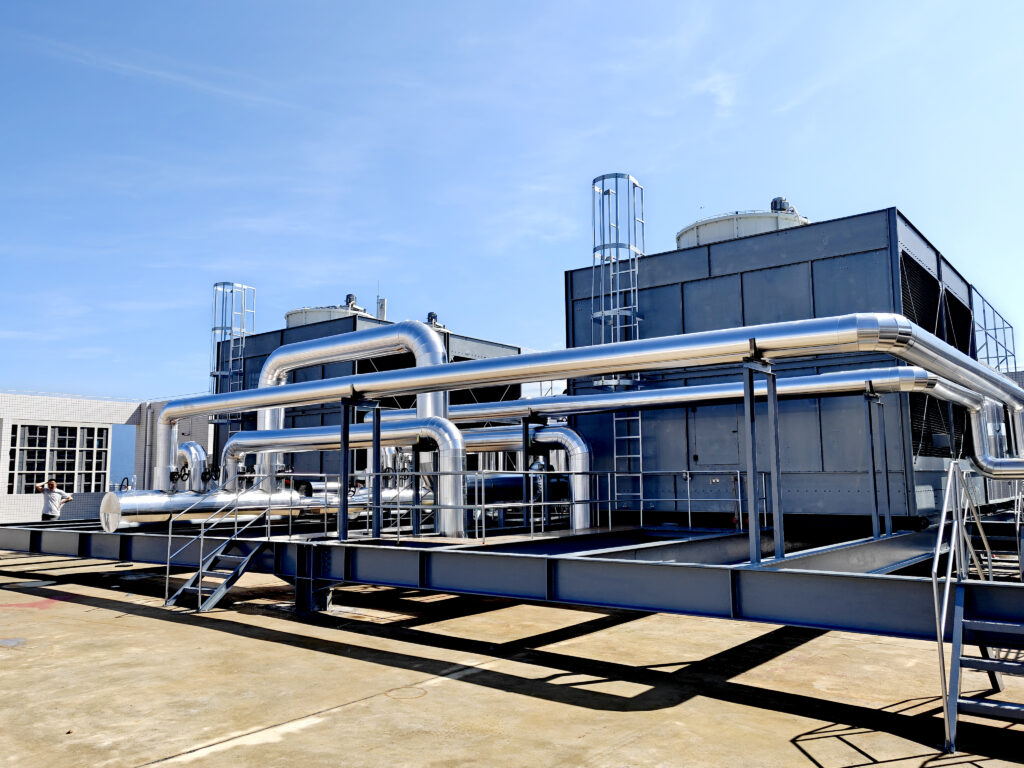
Standard cooling towers work well for many applications. But industrial projects often operate under conditions that standard equipment was never designed to handle.
High process temperatures, aggressive water chemistry, limited installation space, strict noise requirements, extreme climates, and continuous production can all change the way a cooling system should be designed.
For these projects, working with an experienced cooling tower manufacturer capable of custom engineering can significantly improve system reliability.
Industrial Cooling Is Rarely One-Size-Fits-All
Industrial plants use cooling systems for very different processes.
Applications may include:
- Manufacturing equipment
- Industrial chillers
- Process cooling
- Power generation
- Chemical production
- Metal processing
- Refrigeration
- HVAC systems
- Data and equipment cooling
Each application creates different heat loads and operating patterns.
Some systems operate continuously. Others experience large changes in load throughout the day.
A cooling tower must respond to these conditions while maintaining stable outlet water temperatures.
High Ambient Temperatures
Projects in hot climates can be challenging because the available cooling potential changes with local wet-bulb conditions.
Selecting a tower based on inaccurate climate assumptions may lead to insufficient cooling during the hottest periods.
A customized design can adjust:
- Heat exchange surface
- Airflow
- Fan capacity
- Tower dimensions
- Water distribution
These adjustments help maintain performance under demanding summer conditions.
Corrosive Environments
Cooling towers often operate in environments containing moisture, chemicals, salts, or industrial pollutants.
Coastal sites can expose equipment to salt-laden air, while chemical plants may face more aggressive atmospheric conditions.
Material selection therefore becomes a core engineering decision.
Depending on the project, manufacturers may recommend:
- FRP structures
- Stainless steel components
- Corrosion-resistant fasteners
- Specialized coatings
- Resistant fill materials
Matching materials to the operating environment can reduce corrosion and extend service life.
Limited Installation Space
Industrial plants rarely have unlimited space available for cooling equipment.
Retrofit projects are especially difficult because equipment must fit around existing structures, piping, machinery, and access routes.
A custom cooling tower manufacturer may adjust:
- Tower width
- Tower height
- Air inlet arrangement
- Fan configuration
- Basin design
- Connection positions
- Access locations
The objective is to achieve the required cooling capacity without disrupting the surrounding equipment layout.
Low-Noise Projects
Noise limits can become a major challenge near offices, residential areas, hospitals, hotels, or urban facilities.
A standard cooling tower may meet thermal requirements while exceeding acceptable sound levels.
Low-noise solutions can include:
- Low-speed fan configurations
- Larger fans operating at lower RPM
- Optimized blade designs
- Acoustic treatment
- Reduced water-fall noise
- Improved vibration control
Noise performance should be considered during initial system design because correcting it after installation can be expensive.
Water Conservation
Water availability is becoming an important consideration in many cooling projects.
Traditional evaporative cooling provides strong thermal performance but consumes water through evaporation, drift, and blowdown.
Depending on the operating conditions, engineers may consider solutions that reduce water consumption through improved water management, hybrid operation, or alternative cooling arrangements.
The best solution depends on climate, process requirements, energy cost, and available water resources.
Energy Efficiency
Cooling tower energy consumption usually comes from fans and circulating pumps.
Oversized motors, excessive airflow resistance, or poor controls can waste energy throughout the equipment’s operating life.
Custom engineering can improve efficiency through:
- Optimized fan selection
- Efficient motors
- Variable-frequency drives
- Low-resistance fill
- Improved airflow paths
- Intelligent control logic
Instead of running continuously at maximum capacity, the cooling system can respond to actual thermal demand.
Continuous Industrial Operation
Many industrial facilities cannot tolerate unexpected shutdowns.
A cooling tower serving a critical process must therefore be designed with reliability in mind.
Depending on the application, engineers may recommend multiple cooling cells or redundant components.
This approach allows part of the system to continue operating during maintenance or temporary equipment failure.
For high-value production lines, redundancy can protect far more value than the additional equipment investment costs.
Maintenance Access
Maintenance is often overlooked during equipment selection.
Once a cooling tower is installed, technicians need access to inspect and service fans, motors, fill, spray systems, basins, and other components.
Good custom design considers:
- Service platforms
- Access doors
- Internal clearance
- Component replacement routes
- Drainage
- Inspection points
Easy maintenance reduces service time and helps operators keep the tower in good condition.
System Integration
Cooling towers operate as part of a larger system.
Their performance depends on pumps, piping, heat exchangers, chillers, process equipment, controls, and water treatment.
For this reason, cooling tower manufacturers should understand the complete operating system rather than treating the tower as an isolated product.
Engineering cooperation during the design phase can help identify problems before equipment reaches the site.
From Engineering to Long-Term Operation
Custom cooling is not simply about changing the dimensions of a cooling tower.
It means designing equipment around actual operating conditions.
NEWIN supports projects from thermal calculations and customized cooling system design through manufacturing, installation guidance, site commissioning, and long-term spare parts support.
For demanding industrial applications, this engineering-driven approach helps create cooling systems that are easier to install, more reliable to operate, and better suited to long-term performance.