
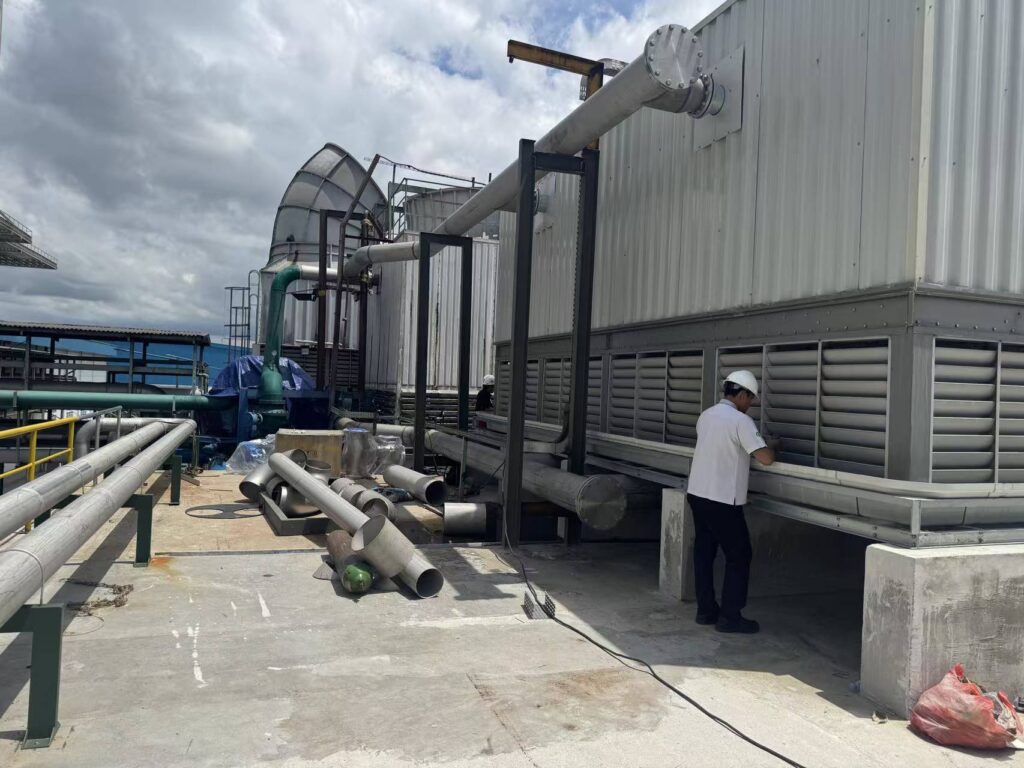
Cooling towers often operate quietly in the background of factories, commercial buildings, refrigeration systems, and industrial plants. But when a cooling tower cannot maintain the required water temperature, the entire system can suffer.
This makes selecting a cooling tower manufacturer more important than simply comparing equipment prices.
A strong manufacturer combines thermal engineering, manufacturing capability, customization, quality control, and long-term technical support.
Here are the main capabilities buyers should evaluate.
Engineering Comes First
Cooling towers operate according to specific thermal conditions.
A manufacturer must understand how factors such as wet-bulb temperature, water flow, heat load, approach temperature, and airflow influence cooling performance.
Accurate engineering helps determine:
- Required cooling capacity
- Tower dimensions
- Airflow requirements
- Fill configuration
- Fan capacity
- Water distribution
- Motor power
Without proper calculations, even well-manufactured equipment may perform poorly after installation.
This is why professional cooling tower suppliers begin with project data rather than simply selecting equipment from a catalog.
Product Range Matters
Cooling requirements vary widely between projects.
An HVAC system serving a commercial building may require a different cooling solution from a chemical plant, steel mill, data center, or industrial process line.
A capable manufacturer should be familiar with several cooling technologies, including open circuit cooling towers, closed circuit cooling towers, evaporative cooling equipment, and customized heat rejection systems.
A wider engineering range allows the manufacturer to select the solution around the application instead of forcing every project into the same design.
Customization Should Solve Real Problems
Customization is valuable only when it improves project performance.
Common reasons for customized cooling towers include:
- Restricted installation space
- Strict noise limits
- Corrosive environments
- High ambient temperatures
- Limited water availability
- Special piping arrangements
- Structural limitations
- Transport restrictions
For example, a compact project may require a different airflow arrangement, while a site near residential buildings may require lower fan noise.
A cooling tower manufacturer with strong engineering capabilities can adapt dimensions, materials, components, and controls around these requirements.
Manufacturing Quality Creates Reliability
The cooling tower must operate continuously under water, heat, vibration, humidity, and outdoor weather conditions.
Small manufacturing problems can eventually become larger maintenance issues.
Reliable production therefore requires control over:
- Structural fabrication
- FRP components
- Water distribution systems
- Fill installation
- Fan assembly
- Motor installation
- Fasteners
- Basin sealing
- Final assembly
Quality checks should continue throughout production rather than only at final inspection.
Materials Must Match the Environment
There is no single best cooling tower material for every application.
Material choice depends on operating environment, water quality, corrosion risk, budget, and expected service life.
For example, stainless steel may be appropriate in more demanding environments, while FRP structures can provide strong corrosion resistance with lower weight.
Other projects may use galvanized steel or combinations of several materials.
The manufacturer should help buyers understand these tradeoffs before production.
Efficiency Affects Total Cost
Cooling tower operating costs continue long after installation.
Fans and pumps may run thousands of hours each year. Poor airflow or inefficient equipment can increase electricity consumption throughout the system’s service life.
A good cooling tower design considers:
- Fan efficiency
- Motor efficiency
- Fill performance
- Air resistance
- Water distribution
- Variable-speed operation
- Control strategy
The goal is not only to achieve the required outlet temperature but to achieve it efficiently.
Low Noise Can Be an Engineering Requirement
Noise is increasingly important for commercial buildings, hotels, hospitals, residential developments, and urban industrial facilities.
Cooling tower noise may come from:
- Fans
- Motors
- Gear systems
- Falling water
- Airflow
Noise reduction can involve low-speed fans, acoustic treatment, optimized fan selection, or modified water distribution.
When noise limits are part of the project specification, they should be considered during design rather than after installation.
Documentation Supports Project Execution
For EPC contractors and engineering companies, cooling tower documentation can be almost as important as the equipment itself.
Useful project documents may include:
- Technical datasheets
- Performance data
- General arrangement drawings
- Foundation drawings
- Electrical requirements
- Installation instructions
- Maintenance manuals
- Spare parts lists
Clear documentation helps designers, contractors, installers, and end users coordinate the system more efficiently.
Global Delivery Requires Experience
International cooling tower projects introduce another layer of complexity.
Equipment may need to travel thousands of kilometers and arrive ready for efficient site assembly.
Manufacturers supporting global projects should understand:
- Export packing
- Container loading
- Modular shipment
- Documentation
- Site installation requirements
- Spare parts planning
Good logistics protect both equipment and project schedules.
Service Should Continue After Delivery
Cooling towers have long operating lives.
Long-term support may include replacement fill, drift eliminators, spray nozzles, fan components, motors, and other parts.
Technical guidance can also help operators maintain stable performance as operating conditions change.
For buyers, this support reduces the risk of being left with equipment that becomes difficult to maintain several years later.
More Than an Equipment Supplier
A good cooling tower manufacturer acts as an engineering and supply partner.
NEWIN supports industrial and commercial cooling projects with thermal calculations, custom design, manufacturing, installation guidance, commissioning assistance, and long-term spare parts support.
For buyers, the real value lies not only in purchasing a cooling tower, but in building a cooling system that performs reliably throughout its working life.